ARLINGTON — As Arlington prepares for the possible impact of winter weather on its streets, Jay Downing, who’s in charge of the city’s maintenance and operations, sees three reasons to be optimistic:
1. Last year’s winter was so mild that the city only had to put down 40 tons of sand and salt on its streets, leaving 150 tons of salt, 100 tons of dry sand, and 450 tons of mixed sand and salt left over for this year.
2. Downing and his workers check the weather forecasts multiple times daily, and all indications are that this winter will be equally mild.
3. Thanks to last year’s light winter, even if this year’s winter turns out to be far harsher than expected, the city still has $25,000 budgeted to keep the streets clear.
“All we’ve had to do so far is lay down one ton of sand/salt mix on Tveit Road,” Downing said. “Thanks to how warm it’s been so far, most of the snow has melted not long after it’s hit the road, thanks to the air pumping up the temperature of the pavement. Even without the sand and salt we’d saved up from last year, we would have had enough money to get us through a tough winter this year.”
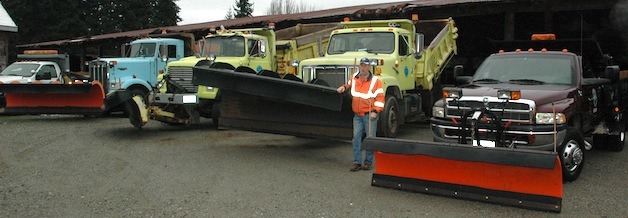
The city’s arsenal of street-clearing vehicles includes one 5-yard and two 10-yard dump trucks equipped with snow-removal equipment, and three 1-ton trucks equipped with plows, placed strategically at the airport, the cemetery and the city’s high-priority streets.
“Plus, we can chain up the grader to plow the roads if it really gets bad,” Downing said.
Arlington’s primary snow- and ice-removal routes include:
• The busiest streets that connect neighborhoods.
• Streets that connect neighborhoods to state highways.
• The streets used most frequently by public safety agencies.
• Streets that serve public institutions, such as hospitals and schools.
• Streets used by transit agencies.
“Once we can get those roads open and clear, then we worry about secondary routes, like hills and residential streets,” Downing said.
“Our top priority is keeping the city’s streets safe, but people should take precautions of their own,” Downing said. “I’ve seen more four-wheel-drive vehicles go into ditches because their drivers got too confident. Just in case you run into a ditch, or a bank, or get stuck, have supplies like water, gloves, lights, blankets and shovels in your rig. Even if you think the roads are okay, watch out for black ice.”
Downing asked for motorists’ and residents’ understanding, as city crews need space and time to clear roads properly. As an example, he pointed out that 172nd Street NE, between I-5 and Highway 9, is only one part of one of his driver’s areas.
“If snow is falling at a rate of about an inch an hour, and it takes the driver forty minutes to clear that stretch of road, then by the time they’re able to come back, three and a half hours later, that’s three and a half inches of snow in the meantime,” Downing said. “Even if they can get back sooner than that, you don’t want them to plow off the sand and salt they laid down. You have to give it time to do its work.”