ARLINGTON Arts in Arlington got a big boost Feb. 18, when the City Council approved four public artworks and $10,000 in matching funds to pay for them, with the other $10,000 coming from the Arlington Arts Council.
Marilyn Oertle, the City Councils representative to the Parks, Arts and Recreation Commission, noted that these funds for public art benefitted from fortuitous timing and budgeting.
The timing actually wasnt right to incorporate the 1 percent from construction projects into public art starting with Olympic Avenue, Oertle said. It was frustrating, but it was great working with my fellow Council members, the mayor and city staff to ensure that it would apply to all future projects. Because Olympic Avenue came in under budget, though, I made the case that we should take that money and apply it toward matching funds for public art.
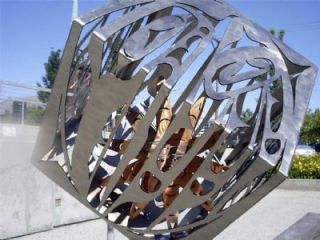
Of the total $20,000 budget for the four artworks selected, $7,000 will go toward James Madisons Raven and the Sun, $4,000 will go toward Harry Engstroms Olympic Avenue mural and $3,500 will go toward Steve Jensens Norwegian story pole. The labyrinth proposed by Sarah Hegge will cost approximately $7,000 for pavers and $2,000 for trees and community labor.
Tulalip Tribes member James Madison created his Raven and the Sun sculpture to retell a story hed heard from his father, grandfather and uncle, and used the medium to reflect the diversity of his heritage.
Theres two different styles there, the Tlingit and the Salish, Madison said. The Tlingit is reflected in the outer structure, the cube, while the lines of the inside are Salish, with crescents and trigons. Both designs are kept separate, because in the story, the raven steals the light of the sun.
Such a complicated structure required many steps, from a pencil sketch to a computer-aided design model, which Madison welded together, grinding the metal to create patterns in its surfaces.
Theres not a whole lot more for me to say, Madison said. Im just dumbfounded to be chosen. As an artist, Im obviously privileged to have my work seen by the public. Arlington is a small community and it says a lot that its willing to give its artists opportunities like this.
Engstrom echoed Madisons gratitude to the Arlington community, deeming it a humbling process to have his work recognized and accepted by the city, but he hopes his acrylic-on-masonry mural will foster a greater appreciation for the natural resources in their backyard.
The Stillaguamish River environment is a treasure, said Engstrom, whose painting on the west side of Olympic Hill will spotlight the native species of the Puget Sound region. Theres an extremely rich myriad of wildlife here that many communities simply dont have, because many of them dont even have rivers, whereas we have both branches of the Stillaguamish.
Engstrom has given himself a flexible schedule within which to complete the mural, starting in April and taking anywhere from four to eight weeks, given that hell be working outdoors in unpredictable weather.
One thing about a mural; you cant take it home to work on it, laughed Engstrom, who will nonetheless be able to shelter his work from light rain. Ill be including the landmarks of the Stillaguamish River, some of the fish species that inhabit and migrate in it and some of its other wildlife, including fishermen. Itll be a sportsmans view of the ecology.
Jensen comes from a long tradition of Norwegian fishermen and boat builders, and for the past two decades his sculptures have drawn from both his experiences and the landscapes hes encountered.
The experiences encompass both my heritage and a broader contemporary circumstance, Jensen said. The landscapes are our seas, waterways, forests and mountains. The abundant beauty of the worlds available natural resources and the precariousness of the relationship that we maintain with them inspire me.
This relationship drives Jensens carvings, which include images from his travels to Egypt, Kenya, Tahiti, India, China and Thailand, and serve as tributes to both the globalism of art and the natural resources that he uses.
All of the wood used in my carvings is naturally felled, Jensen said. No living tree has or will be cut for the sake of this work. The chisels I use have been passed from my grandfather to my father to me. The craftsmanship of my work speaks to the universality and the timelessness of carving. I have found the universal expression of carving throughout each of the cultures I have encountered.
Hegge is quick to deflect too much of the credit for the labyrinth away from herself, but she speaks passionately about it nonetheless.
The concept comes from English garden mazes, Hegge said. Its a landscape piece, a meditation area that asks you to engage your heart, follow a path and quiet your mind. At the middle of the maze, you can sit and think.
Hegge noted that the location of the labyrinth has yet to be determined, but she considered Centennial Trail a possibility. She added that bringing in volunteers to help create it could bring the community closer together.
Its a reminder to slow down and reflect more, said Virginia Hatch, secretary of the Arlington Arts Council and chair of PARC. When citizens can lay their hands on installing it, it instills a pride of ownership. Were really blessed to be at an epicenter of such talented artists. When I hear how other communities select their artworks out of a catalog, I think what a slap in the face it is to their local artists. Were not a cookie-cutter community, and our art should reflect that.
Arlington puts up matching funds for four public artworks
ARLINGTON Arts in Arlington got a big boost Feb. 18, when the City Council approved four public artworks and $10,000 in matching funds to pay for them, with the other $10,000 coming from the Arlington Arts Council.