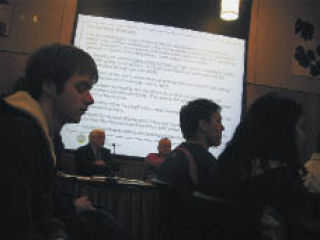
ARLINGTON — City Councilwoman Sally Lien was one of few around the table who remembered a snowstorm comparable to the “Big Snow of 2008” — It was 1950, she said Monday, Jan. 5, when city staff offered a “Post Event Analysis” reviewing lessons learned from the three-week long snowstorm.
“It was a rather large snowstorm,” Public Works Director Jim Kelly stated simply.
“I don’t mean to make excuses, but it was something we haven’t seen in many years.”
His report included the number of hours city employees spent shoveling show: 1,000.
The number of miles the city’s two snowplows had to cover: 160 lane miles. (The airport also has a small snowplow, but it was in use at the airport, he said.)
The number of city employees who cancelled holiday plans and the number of snowplows that could have been used.
“We had piles so big we had to haul the snow to Haller Park,” Kelly said, adding that Washington State Department of Transportation helped with that.
The primary routes on which the city had focused its efforts (Smokey Point Boulevard south to Marysville, 67th south to Marysville, 172nd Street and Cemetery Road, Highland Drive to the hospital, and the roads to the fire stations) were also reviewed.
Responding apparently to the number of frustrated residents who called the city, Kelly explained that they were not able to clear housing developments and cul-de-sacs until late into the three-week storm. Kelly noted that rubber blades were not quite as effective as steel blades and that they have already started training more snowplow drivers.
“The snowplow drivers can not stop and clear the driveways,” Kelly said. “That’s the responsibility of the property owners.” He said they tried to answer all calls.
City Councilman Graham Smith suggested reviewing their definition of primary routes and they scheduled a meeting to accomplish that.
Solutions for the balance of this winter included adding salt to the gravel mixture.
“It’s a frugal mix,” Kelly said. “One part of salt to seven parts gravel. Leroy [Mills] is now building a shelter for the salt,” he added.
Bottom line, he said, the major breakdown was communications.
“We need to get better at communicating to our residents what to expect.”
Kelly suggested posting flyers with information and establishing a hotline for answering questions and informing people of problem areas. He also acknowledged a need for a system to better put volunteers to work, which a member of the audience agreed with enthusiastically.
While Jim Cummins admitted he’s a bit old for shoveling snow, he thought he could have helped in some way.
“I never got a call asking for volunteers,” Cummins said, adding he is a certified CERT volunteer and was waiting for the call.
In conclusion, City Administrator Allen Johnson backed up his staff to the Council, describing all the past four locations he has worked as being snow country (Wyoming, South Dakota, Wisconsin and Colorado).
“This has been second to none of the storms I have seen. I personally slid through three stop signs,” Johnson said.
“It’s a good thing we bought a new snowplow this year.”
The biggest lesson learned?
“Deep snow brings out the venom in all,” Kelly said.
As of press time Monday, Jan. 12, initial estimates of damage from the snow, wind, urban flooding and river flooding are currently hovering around $100,000, according to the city’s assistant administrator Kristin Banfield.
“We expect that this amount will double in the next few days.”