MARYSVILLE – About 15 years ago, when Jacob Newman was in the fifth grade, Hank Palmer was his teacher.
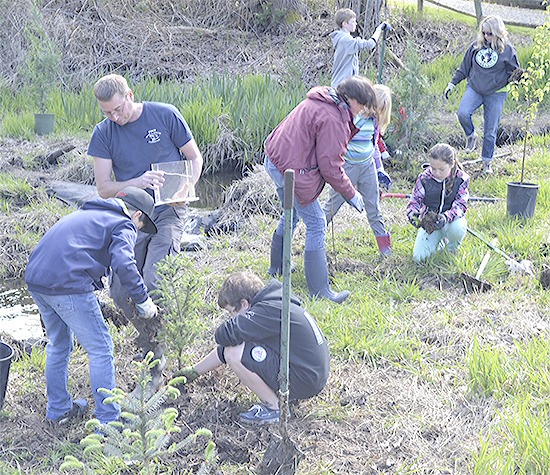
They reunited April 17 but this time as peers as Newman works for Adopt-A-Stream. Students in Palmer’s class were planting trees at Norpoint Park as part of a stream restoration project.
Newman said Palmer was instrumental in inspiring his career. “He had a part in it,” Newman said.
Palmer said he and fellow teacher Jerri Novy as part of the Marysville Cooperative Program at Marshall Elementary stress science.
“We teach science every day,” Palmer said. “We make science happen all the time.”
Newman remembers enjoying Palmer’s class.
“We didn’t do this,” he said of planting trees. “But we did get to go camping. Ever since your class I’ve loved the outdoors.”
Newman said he enjoys seeing students realizing how cool science is.
“It’s awesome seeing the kids out doing this stuff,” he said, adding he’s been working on similar projects in Snohomish and King counties for two years.
The students in Novy’s and Palmer’s classes learned about ecosystems and created field guides prior to the dig. They learned about invasive plants and were heard discussing them while talking about places to plant the trees. They also received an orientation about spacing the trees. They found the digging harder than in previous years because of the lack of rain.
The classes worked with Adopt-A-Stream as part of a Department of Ecology grant to create buffers along Allen Creek. Up to 100 students were set to plant 1,500 trees donated by Project Seawolf. Member Michael Kindu said Seawolf has been doing the project for about 10 years. Survival rate of the trees planted by the students is up to 85 percent.
“The kids get hands-on experience doing real stewardship,” Kindu said.
Ty Kuhlman, a student, picked out the biggest tree to plant, so he was busy working hard on digging the biggest hole.
“It’s a lot of fun,” he said. “You get more exercise and don’t have to learn.”