
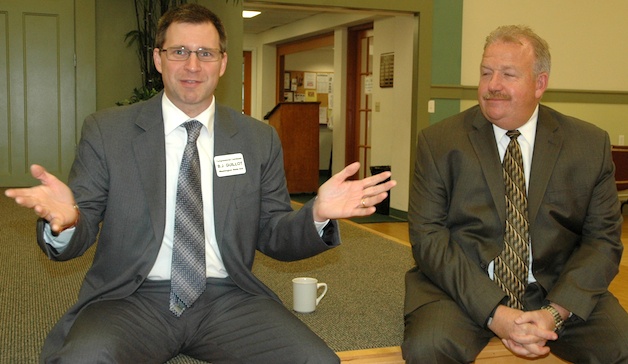
SMOKEY POINT — When Snohomish County Executive John Lovick had to leave early from the Oct. 22 candidate forum at the Stillaguamish Senior Center, Bruce King became the unexpected beneficiary.
King’s fellow candidates peppered him with questions about why he chose to challenge incumbent Dave Aldrich for the non-partisan seat of county PUD commissioner.
“My opponent hasn’t shown up to any of these forums,” said King, an Arlington pig farmer who decided to run after his power went out more than 30 times in just a few months. “He hasn’t put up any signs, and he hasn’t raised any money to campaign. If you’re going to ask for a job, the biggest part is just showing up, and he hasn’t done that.”
King noted that the PUD’s annual budget of $780 million is only slightly less than the county budget of $800 million. He criticized the PUD for raising its rates six times in five years, at the same time he estimated it’s sitting on roughly $350 million.
Neither Aldrich nor U.S. Rep. Rick Larsen, D-Wash., attended the forum, so Larsen’s opponent, Marysville resident B.J. Guillot, asked King how he would address power outages.
“I would look at all our outages and try to find common elements to them,” King said. “Are there tree problems? Do the lines need to be underground? It’s cheaper and safer to do preventive measures. More power linemen die than police officers each year. Keeping the power on saves lives.”
When Smokey Point resident Frankie Savage asked whether she should be concerned with audibly crackling power lines, King described it as a common symptom of wet weather, including humidity, and added that 25 percent of energy is typically lost in transmission.
King then expressed his support for solar power, proposing that houses with electric cars could be used to boost the PUD’s temporary power storage capacity.
“Most of the time, your car is sitting in the garage, so during those hours, the cars’ batteries can be used to store additional power,” King said.
Jim Upton, the challenger for the county sheriff’s seat, also didn’t attend, so Guillot also posed questions to incumbent Sheriff Ty Trenary. When Guillot expressed concerns about NSA surveillance, which is one of his reasons for running, Trenary agreed with him that such measures went too far.
“I believe in adhering to the Constitution,” Trenary said. “It’d be nice for law enforcement to have the information from that surveillance, but we need to obtain it lawfully.”
When Guillot inquired whether meth or heroin was a bigger problem within the county, Trenary reported that heroin is now available more cheaply.
“Meth was a big, scary problem for a while, especially when you heard about meth houses blowing up,” Trenary said. “We’ve legislated ourselves at least partly out of that problem, thanks to the same laws that make it so much harder to buy certain types of medication.”
By contrast, Trenary deemed excess prescription medications in people’s homes to be a far bigger problem now, since teenagers are able to get high off drugs that their parents have often forgotten that they still own. To that end, he explained that unused medications that turned over to the county are incinerated.
Savage’s observation that the sheriff’s office is “losing a lot of lawsuits” prompted Trenary to reiterate that the county jail is being overtaxed by housing non-violent homeless, mentally ill and drug offenders.
“We’re removing those people from sight, but we’re not really solving the problem,” Trenary said. “They don’t come out of the jail any better, so it becomes a revolving door.”
Trenary laughed and expressed surprise when Carolyn Eslick, the mayor of Sultan who’s challenging Lovick for the county executive seat, agreed with the sheriff’s emphasis on better mental health care options and private/public partnerships to address homelessness.
“We started the county’s first family support center in Sultan in 1992,” Eslick said. “Two years ago, there was a meeting about establishing a psychiatric hospital here in Smokey Point. I spoke out in favor of it, but I was the only elected official in the room. It’s coming, but it’s a drop in the bucket compared to what’s needed.”