ARLINGTON Andrea Miller has had a passion for trains and railroads ever since she was a little girl. It all started when she visited her grandparents in Marysville and would lay in bed at night, listening to the trains, wondering where they were going. Later she went to Alaska with her grandfather and rode the train from Anchorage to Fairbanks.
Ill always remember that experience, Miller said, while reviewing the process for creating a historical plaque on the role of the railroad in Arlingtons history for the Centennial Trail.
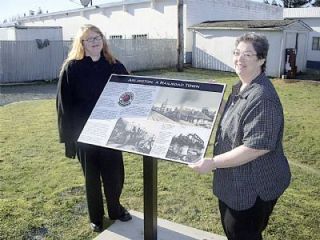
Miller is a member of the city of Arlingtons Parks, Art and Recreation Commission and she volunteered to do the research and design the plaque, which was paid for by the Arlington Garden Club and the Arlington Kiwanis Club.
I got a lot of the information from the Arlington Centennial book, which was compiled by the Stillaguamish Valley Genealogical Society, Miller said. And the photographs came from the Stillaguamish Valley Pioneer Association. I cant say enough about how helpful they were.
The railroad history plaque was installed last fall, but got lost in the shuffle of the grand opening celebration of North Olympic Avenue.
Miller attributes the brainstorm to Virginia Hatch, chair of the PARC. A features editor for the Enterprise newspapers in south Snohomish County who lives here in Arlington, Miller has offered to work on another plaque about the history of dairy and farming in the valley.
Hatch is very excited to make progress on a vision she has for Arlingtons downtown section of the Centennial Trail, which will eventually span the entire Snohomish County.
The trail has huge potential for economic development, Hatch said. I want Arlingtons section of the trail to be fully prepared when cyclists start rolling in from the urban area to the south. Our vision for the trail will make the experience interesting and information for visitors and locals alike.
The long-range plan is to dedicate each downtown block to different aspects of Arlingtons history, said Hatch. She welcomes contributions from other Arlington service groups to get involved in this project which started with sculptures and benches during the citys centennial celebration in 2003.
The Railroad History plaque is south of Fourth Street, behind the building on Mary Greens store, Evonnes Collectibles, which is host to Harry Engstroms mural, The Run of Engine No. 1, which was created by Engstrom and his students in a mural painting class at the Stillaguamish Valley School of homeschoolers. It was the Stilly Schools contribution to the citys centennial celebration.
We plan to put more sculptures that fit the theme for each block, with benches and historical plaques and other artifacts, Hatch said. Recently she took a walk with Bill Blake, the citys natural resource manager, to select a location for a big log to be used as a bench in the logging history block. Plans are in the works to place Steve Jensens carved wood Scandinavian Pole in that logging block and the garden club has agreed to plant some evergreen shrubs along the chainlink fence.
The garden club has been planting dogwoods along the trail for some time already, Hatch said.
So far, Verena Schwipperts Salmon Spawning Pool fish bench sets the mood for the Native History block, between Burke and Division streets. James Madisons Grandfather metal bear sculpture will eventually be relocated from the 400 block to that block, with the fish bench and landscaping that features native northwest plants as well.
From Fifth to Fourth street the theme is dairy and farming history, to go along with the Stilly Valley Victorian old farmhouse mural on the back of MeLady Lanes bowling alley.
The Fourth to Third street is well on its way on the railroad history theme, and airport history will be located south of City Hall, somewhere around Legion Park, depending where the restrooms and a proposed labyrinth end up, Hatch said.
The railroad history plaque features three historical photographs, one by Jim Frederickson, of the Darrington Logger engine 1612 arriving at the Arlington depot on May 25, 1955; one of the Galloping Goose, a gas-powered rail car which provided passenger service between Arlington and Darrington, a photograph provided by the Stillaguamish Valley Pioneer Museum. The third picture on the plaque shows a steam engine crossing the Haller Bridge over the Stillaguamish River, circa 1900, also provided by the SVPM.
The story of Arlington on the Centennial Trail
ARLINGTON Andrea Miller has had a passion for trains and railroads ever since she was a little girl. It all started when she visited her grandparents in Marysville and would lay in bed at night, listening to the trains, wondering where they were going. Later she went to Alaska with her grandfather and rode the train from Anchorage to Fairbanks.