ARLINGTON This years Fly-In at the Arlington Airport marked a resurgent presence of veterans, not only in the form of military vehicles and weapons, but also in the number of former service members, both as attendees and as honored guests.
The Paul Allen Flying Heritage Collection was once again on hand to offer tours and showcase selected pieces from their assemblage, which this year included a Kettenkrad, a unique vehicle which comes from the arsenal of Germany during World War II. The Kettenkrad looks like a hybrid of a motorcycle and a miniature tank and was employed for a variety of purposes in WWII. At the start of the war Germans used it to lay communication cables, but as aircraft fuel became relatively scarce in their country near the end of the war, the Kettenkrad wound up pulling jet planes on the runways.
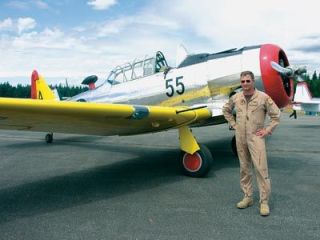
The Heritage Flight Museum of Bellingham was also represented, as its executive director Greg Anders, a lieutenant colonel in the Air Force, brought a trio of warbirds to the Fly-In, including a North American SNJ4 that likewise dated back to WWII.
My dad was in the military and I just got bit by the flying bug, said Anders, who served 15 years active duty, six years in the Air Force National Guard and the past year in the Civil Air Patrol. Theres just something about the feeling of being up in the clouds, off the ground and seeing the world from the perspective of the birds.
Anders sees the museum as a way of giving back to the service that he received so much from and conceded that being able to fly the historic planes is a fun bonus. He went on to thank the airport, city and community of Arlington for their support over the years.
Unlike Anders, whos been a regular presence at the fly-ins for the past seven years, the Puget Sound Military Vehicle Collectors Club has been unable to attend the Fly-In since 2004, but PSMVCC event coordinator Bill High pledged that the groups attendance of this years Fly-In would be repeated as often as possible. Even after the group conducted a parade of jeeps, scout cars, half-tracks, trucks and ambulances down the flight line July 15, its members were still eager to show off their wares.
We want to preserve military history through private ownership of military vehicles, from WWII and Korea through Vietnam and Operations Desert Storm and Desert Shield, right on up to current hostilities, High said. A lot of our people have prior service, but not all, and its not required. Its not even mandatory that you own a military vehicle, just that you want to participate in their preservation. Our goal is to preserve our countrys heritage of contributions to freedom, one vehicle at a time.
Chris Broom is long since retired from the Army, but hes spent years of his civilian life restoring his White M-16 A-1 multiple gun motor carriage from WWII.
These reached the end of their usefulness in the late 50s and were surplused in the early 60s, said Broom, who estimates that he spent 18 months and between $25,000-$30,000 rebuilding the vehicle, from both original and replica parts. In the civilian market, they were often converted to flatbeds for farmers and utility workers. I had to replace everything from the cab back. Just gathering all the parts took me a year.
Broom chose this vehicle because of its distinctive appearance and historic significance.
Id only seen it in pictures and in movies, Broom said. This was part of our arsenal of freedom in Europe, where the rubber tracks proved especially useful on those old cobblestone roads. Its a reminder that, not that long ago, somebody really did try to take over the world.
William Holloman is a living reminder of our nations history of military service, since he spent 30 of his 83 years serving in the military, starting in 1942 as a Tuskegee Airman. Holloman signed books about the Tuskegee Airmen at the fly-in to raise money for the Tuskegee Airmen Scholarship Fund, which grants scholarship awards to young men and women without regard to race, creed or color, and he sees his role as an educator for the generations that have followed in his wake.
I want our young people to have sense of history about our wars, said Holloman, who has worked as a teacher, among many other jobs, in his civilian life. Its embarrassing to me when I walk up to a young person and ask them about WWII, or Korea, or Vietnam, and they dont know anything. We neglect our young people in school.
In spite of his tongue-in-cheek insistence that he joined and stayed in the military for so long because he was lazy, Holloman has plenty to teach people of all ages about perseverance.
I remember the stupidity of segregation, Holloman said. On a train trip from Indiana to Kentucky, the conductor insisted that my fellow cadets and I give up our compartment and move to the segregated car. We refused, so the conductor called the military police. A lieutenant overhead and told the MP sergeant that the government had paid for our car, and it would decide who rode in it, not the conductor. We were still forbidden from going to the dining car, so they brought us our food in our compartment. In the end, they uncoupled the car our compartment was in from the rest of the train, just so they could force us to sit in the Jim Crow car, right behind the engine. Our uniforms were tan, but they were black with soot by the time we arrived in Kentucky.
Holloman admitted that such incidents caused him to wonder what I was fighting for, but his love of both flying and country kept him in uniform and on duty.
I tried to sign up the day after Pearl Harbor, but I was only 17, so my mother had to sign off on it, and she wouldnt, Holloman said. Our success in WWII helped convince President Truman to issue Executive Order 9981, which integrated all the armed forces.
Veterans make presence felt at Fly-In
ARLINGTON This years Fly-In at the Arlington Airport marked a resurgent presence of veterans, not only in the form of military vehicles and weapons, but also in the number of former service members, both as attendees and as honored guests.