Footballers talk about responsibility and duty on and off the field
To make anything work and work well, you need leadership. Its one thing to have a willing and dedicated team be it in business, sports or society. But a great team needs to guided and thats where leadership comes in. Thats what makes veterans like former Mariners pitcher Jamie Moyer and Seahawks quarterback Matt Hasselbeck so special. They lead by example on and off the field.
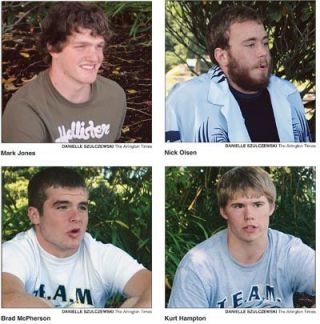
Darrington and Arlington are replete with athletes like Moyer and Hasselbeck. In particular are Nick Olsen, 18, a senior at Darrington High School and a tackle for the Loggers and who is considering going to Eastern Washington State to study math; Mark Jones, 18, a senior at Darrington High School, quarterback for the Loggers and who is looking to attend college outside Washington; Brad McPherson, 18, a senior at Arlington High School, full back and outside linebacker for the Eagles and who wants to go to the United States Military Academy at West Point in New York; and Kurt Hampton, 18, a senior at Arlington High School and tackle for the Eagles who wants to attend Washington State Universitys pharmaceutical program and eventually own his own pharmacy.
Each of these young men have been exemplary leaders on and off the field. But where did these skills come from? Why and how do they exhibit leadership? The Arlington Times wanted to know and met with the players in downtown Arlington for a group interview to discuss leadership.
What attributes should a leader have?
Nick Olsen: Cant be shy. Got to be pretty smart to lead the other kids and make sure they dont do anything wrong.
Mark Jones: Cant be soft on them. You have to be hard. No let downs.
Brad McPherson: Have to lead by example and be enthusiastic.
Kurt Hampton: Its always great to lead by example. You have to be expressive. You have to express what they need to do and always make sure they understand whats required.
What are some ways you show leadership on the field?
NO: I always try to go first to make sure the younger kids know what the drill is, and that they know what to do.
MJ: I just make sure they all know what theyre doing and if they have questions I give them answers.
BM: I always try to be first in line and you can ask Kurt, Im the loudest guy out there. I scream and yell a lot.
KH: Definitely lead by example, be the first in line. And also offer up advice, coach them up, see if they want to come after practice and see if there is something you can work with them on to help them.
What is a specific example of that?
NO: My linemen, Im rough with them maybe. If theyre slacking Ill slap them upside the helmet and ask why werent you on that block, why didnt you get in there.
MJ: I get on their case. I yell at them for a minute and then ask if they know what they did wrong then run the play over and over again until they get it.
BM: First of all I try to tell them what they did good. Then Ill tell them what they did bad. But most of the time just saying nice play.
KH: You always focus on things theyve done. If they do it well, then you give them props. If they do it wrong then coach em up. Encourage them that theres always the next play. You have to focus on whats upcoming and to drop the last play. You have to encourage them to get up and try it again. There was a play when our center jumped offsides and hes the one whos supposed to really know the snap count so I just went over and said, Hey just forget about it. Just wipe it clean. This is the first time youve messed up in a long time. Just take it play by play.
BM: One of my guys, probably the best athlete on the team, when he drops the ball he totally freaks out and I just told him to calm down. We look up to him and if he freaks out we all start freaking out. Once I get him to calm down then we all start to calm down.
MJ: Yesterday we had a kid, I called a 47 Power and he went to the wrong side and he was pretty upset with himself. I told him, You know what you did wrong and lets run it again. Youre going to get it right.
NO: Our starting guard had pulled something in his leg, so our second guard in there and hes a little unsure about the plays and is still finding his way a little bit. I teach him a little on each play. Im constantly there to make sure he gets it.
How do you show leadership off the field?
NO: Im in the National Honor Society and we help the town out with fundraisers and whatever. I sometimes take leadership position on that, try to get everyone organized and get stuff going.
MJ: I coach little kids, I referee little kids basketball.
BM: Im also National Honor Society. Im the student advisor to the Arlington School Board and also, a lot of my friends tend to be on the party side. And I try to keep them clean during the football season. I try to hang out with them 24/7. When people say, You are your friends. Im not my friends. I hang out with them like crazy but I dont do the stuff they do. During the football season Im on their case 24/7. I do it because I want them to succeed in life. I care for them off the field. I want them to play football and I want them to take the right road, not go down a path and drop out.
KH: I participate in a program called Santas Helpers. It takes families in need and you get as much fundraising as you can, to bring money, food and presents and you take them to these families in need so they can enjoy the holidays and have a good Christmas, Thanksgiving or Hanukkah. Its a real good program. I also work on Trunk or Treat, where you get a bunch of the underprivileged and they walk along the street and instead of going to houses, theres a lot of cars lined up along the street with their trunks open and its a way for the kids to get out be able to enjoy something they might not have been able to because their parents couldnt afford it.
How do National Honor Society or Santas Helpers make you better athletes?
BM: It makes others look up to you and you get used to having that higher position. When youre helping little guys, theyre all around you and youre already starting to become a leader amongst others.
NO: For National Honor Society, it gets the town involved and they know who you are and they show up for games and the atmosphere there just gets way more intense.
MJ: When I help little kids, they come and support the team better. And I guess they look up to us.
What pushes you to do these things, volunteer, lead.?
NO: I like helping people and the National Honor Society is a good way to do it. I like being in groups. You have to do an essay to join it so its all on me.
BM: I enjoy helping others. Im was junior class president and I dont know, I just like helping others.
Do you think people around you see you as a leader?
KH: Id say yeah that they do. Its really cool when youre working with the first team offense in football and you see the younger kids, they watch. They want to look at you as that idol, that person who they can learn from. I would say from a football standpoint they definitely view us as leaders.
BM: Yeah, Kurt is also the captain of the track team so he has leadership under his belt. I was captain of the football team last year voted by my teammates. Im the captain of the basketball team this year. Its all voted on by my teammates so I think they look up to me as a leader.
MJ: I was voted captain for football. I respect them and they respect me.
NO: Im more of a silent leader. I dont do anything that would bring us down or anything. I try to keep it positive. I just kind of have an aura I guess.
What is the hardest part about being a leader?
NO: You can never drop the ball. People are looking up to you and so if they see you do something stupid, they think, Well if he can do it, then I can do it.
MJ: Theres a JV quarterback who always comes up to me and asks me what to do and if I ever mess up, I get down on myself because I was showing him what to do and I was doing it wrong, so I get down on myself sometimes.
BM: Not failing. Doing something wrong and not showing everyone that youre messing up. If were all happy with everybody, the whole team rises up. But if were down, the whole team swoops down.
KH: Whats really dangerous about being a leader is that because there is that pressure to be that stand-out, work-hard, always-expressive person, sometimes if you get down, the team gets down, too. So you have to watch out because there is an effect that you have and you always want to stay positive. Ive always been hard on myself when I mess up. I always go through several mental reps after I make a mistake because I want to make sure I wont make that mistake again. And Ive got to work to make sure that those underneath who are playing behind me dont see that as me getting down but as a way to improve. You have to keep working forward.
Are you born with leadership or is it learned?
BM: I think its half and half, because Im not shy at all, I was born with being that crazy, out there, yelling and screaming for everybody and my dad raised me to lead others.
MJ: When I was in middle school I didnt have any desire to lead. When I got into high school, I watched my sister all through high school play and she was the leader and that taught me how to lead.
NO: I think its learned through life. In elementary school and middle school, I wasnt much of an athlete, just a kid going to school. I was always good in class. Then in my freshman year, something switched. Im not sure what happened, but people started to look to me for answers. It just kind of comes from somewhere.
How will being a leader help you after high school?
Being a leader will definitely help us in college and will stick with us.
What leader do you admire?
NO: Mr. Eckerson, my Spanish teacher. Hes always getting stuff together, rallying the kids to go do stuff, not just sit around. We got our recycling program in Darrington going. Hes a stud.
BM: My basketball coach Mr. Brown. I look up to him because half the time when we condition as a team, he gets out there and conditions with us. And my other coach, Mr. Hunter, our receiver and quarterback coach. When I was younger, I didnt like him at all. But hes one of my favorite coaches of all time. He always points out the good. Hell show you what you did wrong, but he tells you what you did right and makes you feel awesome. And the other is my dad.
KH: Yeah, two teachers here, Mr. Hunter is one of them and an ex-teacher of ours Mr. Richardson who is now head coach at Squalicum. What was important about him is that he taught me how important hard work was and how if you work hard enough, people will recognize what youve been doing. When you go out there two hours early and youre kicking or throwing or working on blocking technique two hours before the team gets there and then you stay afterwards, people look up to you for that. They understand that what youre trying to do is better yourself so the team will be better and he really taught me that and Im very grateful for that.
MJ: My baseball coach Ron Smith. He taught me a lot about baseball and I want to go play baseball at the next level and he taught me how to play at the next level. He told me he wants me to, so I really respect him for that.
It takes a leader
Footballers talk about responsibility and duty on and off the field